
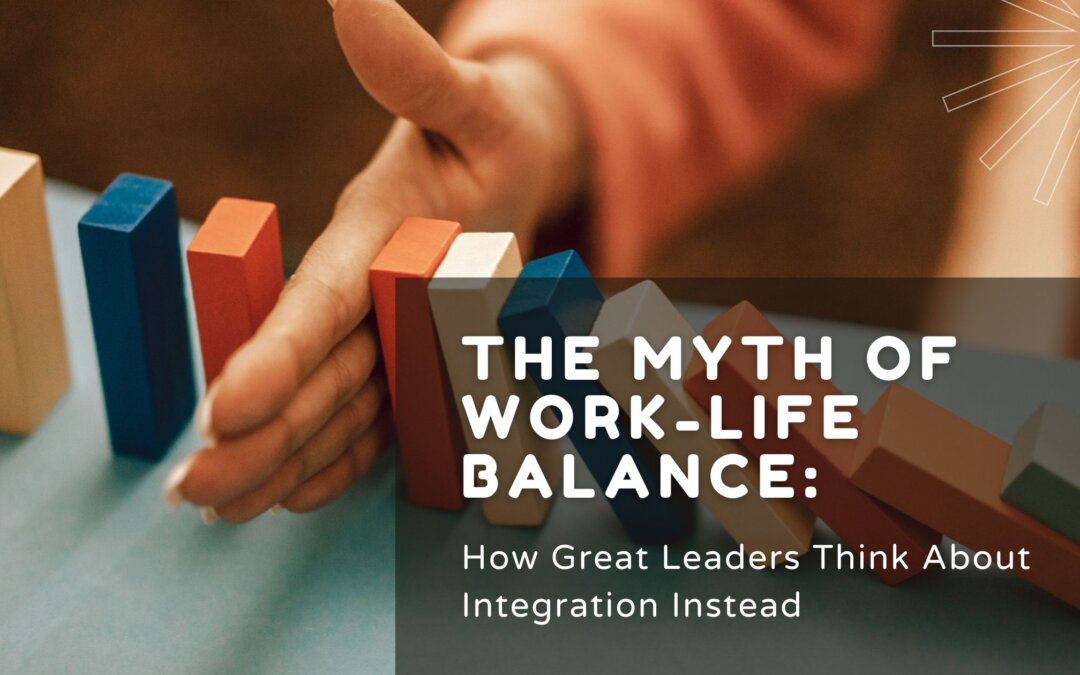
Work-life balance has become the holy grail of modern leadership discussions. Yet despite endless articles, workshops, and coaching sessions on the topic, leaders report feeling more overwhelmed and out of balance than ever.
Here’s the uncomfortable truth: traditional work-life balance is a myth—an unattainable ideal that sets leaders up for frustration and failure.
The problem lies in the metaphor itself. “Balance” implies equal, static distribution—a perfect equilibrium that rarely exists in the dynamic reality of leadership roles. It also reinforces an artificial separation between work and life, as if one isn’t a fundamental part of the other.
The most effective leaders I’ve observed have rejected the balance paradigm entirely. Instead, they practice what I call “purposeful integration”—a fundamentally different approach to managing energy across all areas of life.
Research from the Harvard Business Review supports this shift, finding that leaders who integrate work and personal life intentionally report higher satisfaction and better performance than those pursuing traditional balance.
Purposeful integration is built on three principles:
First, focus on energy management, not just time management. The key question isn’t “How do I allocate hours?” but “How do I invest my energy in alignment with my values?”
Second, reject false dichotomies between work and life. Seek synergies where personal passions fuel professional performance, and vice versa.
Third, design for rhythms rather than balance. Life moves in seasons and cycles, not in perfectly balanced days. Plan for intensity and recovery rather than constant equilibrium.
A software executive I coached transformed her approach from struggling with balance to embracing purposeful integration. She stopped trying to maintain strict boundaries between work and family time and instead focused on being fully present in whatever context she found herself. She also created deliberate recovery rhythms—periods of lower intensity that followed naturally after high-demand phases.
Practical steps toward purposeful integration include:
Conducting a “values audit” to identify what truly matters across all domains of your life.
Creating “transition rituals” that help you shift mental states between different roles and responsibilities.
Designing your physical environment to support integration—like home office spaces that can transform for family activities.
Communicating clear expectations about your availability and responsiveness.
Remember, the goal isn’t perfect balance—it’s meaningful alignment between how you invest your energy and what you truly value. Some weeks will skew heavily toward professional demands, others toward personal priorities. The integration mindset accepts these fluctuations as natural rather than viewing them as failures of balance.
Great leaders don’t achieve perfect work-life balance. They create purposeful integration that honors the complex, interconnected reality of a leadership life.